Brandon went from a village of eight thousand in the early 1960s to a hundred and fifteen thousand today, and the surge came when I-75 connected in 1986. Around 43 percent of the housing predates 1990 and roughly 63 percent predates 2000 — which means most of Brandon was insulated to a standard that is now roughly half of what the code requires, and it has been settling ever since.
The Brandon attic problem
The build-out was remarkably concentrated: 21.7 percent of homes went up in the 1980s, 20 percent in the 1990s, 21.2 percent in the 2000s. The median Brandon home was built in 1993.
Homes from that era were typically built to R-19 or R-30 in the ceiling. Current code for this climate zone is R-38. Thirty to forty years later that insulation has settled, compressed, been wind-washed thin at the eaves, and been walked through and displaced by every roofer, cable installer, HVAC tech and pest control visit since. It measures far below what it started at, let alone what it should be.
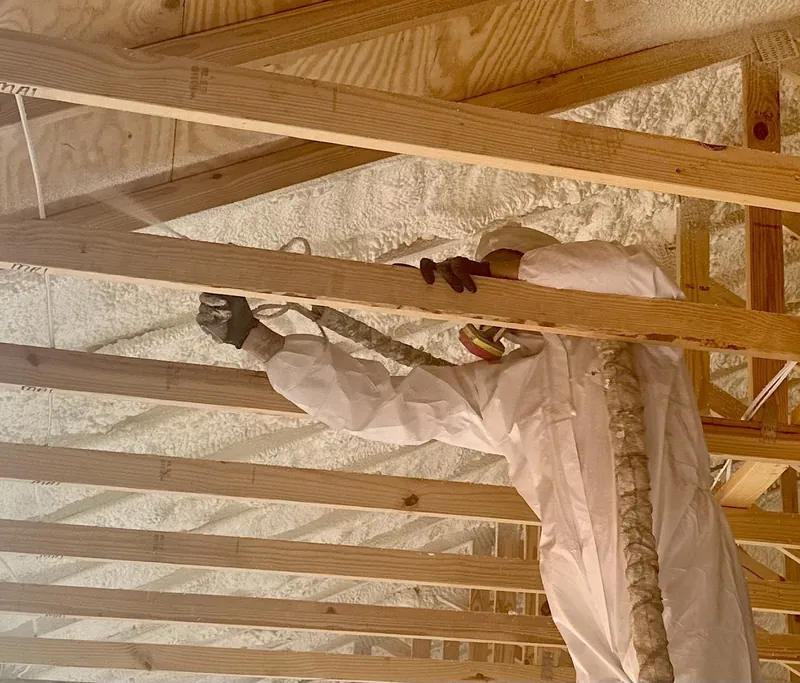
The second problem compounds the first. Brandon has a lot of two-story homes with the air handler and the duct runs sitting in an unconditioned attic. That means the equipment cooling your house is itself sitting in the hottest part of it, pushing air through ducts that leak. Sealing the attic at the roofline with spray foam brings that ductwork inside the conditioned envelope, and in a two-story Brandon house it is usually the single change that makes the biggest difference.
Neighborhoods where we see this constantly: Sterling Ranch (1989–1997), Brandon Traces (1987–1993), Dominion (1991–1996), Bloomingdale Village (1997–2000), Heather Lakes, Providence Lakes, Brandon Hills, Barrington Oaks and Kensington Estates. Alafia Estates along the river runs older, from 1970. Newer gated communities like Arbor Oaks (2015–2018), Lumsden Reserve and Brandon Pointe are in better shape but still have attic ductwork.
Tampa Electric rebates
Tampa Electric pays $0.16 per square foot for every R-11 of insulation you add to the ceiling, and there is no published cap on it.
The pre-approval inspection is mandatory, and it is the step that catches people out. A TECO energy analyst has to inspect the attic before any work begins. If insulation is recommended they issue a rebate certificate valid for one year, plus a list of approved contractors. Do the job first and there is no rebate at all. The claim is then due within 90 days of completion. The inspection is free and you book it on (813) 275-3909.
Worth asking about on the same call: TECO will seal your ductwork for a flat $125 per heating and cooling system after a free inspection, and they estimate leaky ducts cost up to twenty percent of annual heating and cooling. Given where the ducts run around here, that is usually the best money on the whole job. There is also a Neighborhood Weatherization program providing free ceiling insulation and free duct sealing to qualifying households in designated communities.
Two things TECO does not offer, whatever you read elsewhere: there is no window rebate and no financing program. Old listings showing $2.65 per square foot for windows are from 2015 and long dead.
You are at work when your attic is at its worst
The average Brandon commute is nearly 28 minutes and 78 percent of people drive alone — the Selmon Expressway even runs its express lanes westbound in the morning and eastbound in the evening, which is a fair description of the daily tide toward Tampa.
That matters more than it sounds. Ninety-four days a year here reach 90 degrees or above, humidity averages 74 percent, and the peak attic heat arrives in the middle of the afternoon — while the house is empty and the thermostat is still holding a temperature. The air conditioning is fighting the attic all day for nobody. An under-insulated ceiling costs the most precisely when no one is home to notice.
Brandon is inland, about eleven miles from downtown Tampa, so it sits largely outside the coastal surge evacuation zones. The exposure here is wind, wind-driven rain and tree damage rather than surge — Milton brought gusts near 96 mph at Tampa International in October 2024. A breached roof soaks the attic insulation, and wet insulation in this humidity does not dry out. It compacts, loses its R-value permanently and grows mold, which is why removal rather than drying is the correct answer.
Common questions
How much insulation should a Brandon attic actually have?
Current Florida code for this climate zone calls for R-38 in the ceiling, and the Department of Energy's guidance for an uninsulated attic here runs R-49 to R-60. The median Brandon home was built in 1993 to roughly R-19 or R-30. So the typical house in Sterling Ranch or Brandon Traces is sitting at somewhere between a third and a half of what it should be — and that is before you account for thirty years of settling.
My upstairs is always hotter than downstairs. Is that the insulation?
Partly, but in Brandon it is usually the ductwork as much as the insulation. A great many two-story homes here have the air handler and the supply runs sitting in an unconditioned attic that reaches well over 120 degrees on a summer afternoon. Cold air traveling through leaky ducts in that environment arrives upstairs warm and weak. Sealing the attic at the roofline brings the equipment inside the conditioned envelope and fixes the cause rather than the symptom.
Do you have to remove the old insulation first?
Not always. If the existing material is dry, clean and evenly spread, topping it up with blown-in is usually the better value. It has to come out when it is wet, when there is rodent contamination, when it has been compacted or displaced across most of the attic, or when we are foaming the roof deck. We check this at the estimate and tell you which one you have before quoting.
How long does an attic job take?
Most Brandon attic jobs are a single day, and you can be in the house while we work. Removal adds time because the old material has to be vacuumed out and bagged before anything new goes in. Roofline spray foam on a two-story house is usually a day, occasionally two. We give you the realistic timeline at the estimate rather than the optimistic one.
Will the Tampa Electric rebate cover the whole cost?
No — it offsets part of it. TECO pays by the square foot for added ceiling insulation, which on a typical Brandon house is a useful contribution rather than the whole job. The important thing is the order: the free TECO inspection has to happen before any work starts, or the rebate is void entirely. Book that first, then get quotes.
Where we work
Across Brandon and the surrounding communities — Sterling Ranch, Brandon Traces, Dominion, Bloomingdale, Heather Lakes, Providence Lakes, Alafia Estates, Arbor Oaks, Hidden Reserve, Brandon Hills, Kensington Estates, plus Valrico, Seffner, Limona and Bloomingdale.
We install open-cell and closed-cell spray foam, blown-in insulation, and handle insulation removal when old or storm-damaged material has to come out. We also fit energy-efficient windows and repair storm damage.