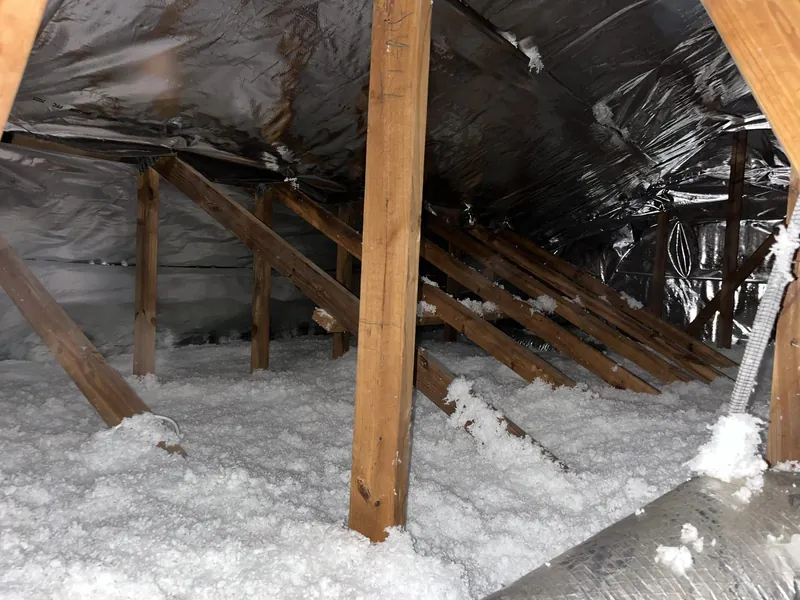
In a Florida house, the ceiling is where most of the money leaves. A vented attic under dark shingles runs thirty to fifty degrees hotter than the air outside through the afternoon, and it goes on pressing that heat down into your rooms for hours after the sun is off the roof. Whatever sits between that attic and your ceiling is the only thing standing in the way — and in most houses around here, there is far less of it than there should be.
How much insulation should a Florida attic have?
The Florida Building Code divides the state into two climate zones. Climate Zone 1 — the far south of the peninsula — requires a minimum of R-30 in the ceiling. Climate Zone 2, which is every county we work in, requires R-38.
That is the minimum for new construction. It is not a target you have to hit on an existing house, and nobody will make you. But it is the honest benchmark, and it is worth knowing where you actually stand against it before anyone quotes you anything.
What R-38 looks like depends entirely on the material:
- Blown-in fiberglass — roughly R-2.5 per inch, so somewhere around fifteen inches of depth.
- Blown-in cellulose — roughly R-3.5 per inch, so around eleven inches.
- Open-cell spray foam — roughly R-3.7 per inch, though foam is normally applied at the roofline rather than the ceiling, which changes the whole calculation.
- Closed-cell spray foam — roughly R-6.5 per inch, and it acts as a vapor retarder as well.
Those are approximate figures and they vary by manufacturer and by how the material is installed. Depth alone is not the whole story either — insulation that has been compressed measures far below what its thickness suggests.
The thirty-second check you can do yourself
You do not need a contractor to know roughly where you stand. Open the attic hatch, shine a torch across, and look at the wooden ceiling joists.
- You can clearly see the tops of the joists — you are at roughly R-19 or less. Half of code, or worse.
- The insulation is level with the joists — roughly R-19 to R-30. Still short.
- The insulation sits several inches above the joists — you are somewhere near R-38 and may well not need us.
In a Polk County house built in the 1970s or 80s, the joists are usually visible. We would rather you knew that before we arrive than after.
Why Florida attics lose their insulation
Insulation does not fail so much as it gets worn away, and almost always in the same handful of ways.
It settles. Loose fill compacts under its own weight over decades. What was blown to R-30 in 1988 does not measure R-30 today.
It gets walked through. Every roofer, HVAC technician, cable installer, plumber and pest control visit since the house was built has crossed that attic. Each one flattens a path and pushes material aside.
It gets wind-washed at the eaves. Air entering the soffit vents scours the insulation thin around the perimeter of the attic — exactly where the ceiling meets the exterior wall, which is the worst place to lose it.
It gets buried under storage. Anything stacked on the attic floor compresses the insulation beneath it to a fraction of its rated value.
It gets wet. A breached roof, a leaking supply line or wind-driven rain through the soffits soaks it, and in Florida humidity it does not dry out. Saturated fiberglass and cellulose mat down and never recover their loft.
The part most attic quotes leave out
Insulation slows heat moving through a surface. It does almost nothing about air moving around it. Those are two different problems, and only one of them gets talked about on most quotes.
A typical ceiling is punctured dozens of times — around the top plate of every interior wall, at every plumbing and wiring penetration, around bath fans and recessed lights, and at the attic hatch itself. Those gaps let conditioned air out and pull attic air in, and blowing two feet of loose fill on top of an unsealed ceiling does not close a single one of them.
The State of Florida's own guidance is explicit about the order: seal the openings and cracks along the ceiling, at light fixtures and at the top and sole plates before the insulation goes in. It costs a fraction of what the insulation costs and it is a real share of the comfort improvement.
If a quote does not mention air sealing, it is a thinner job than it appears.
When the answer is the roofline instead
There is one situation where adding depth at the ceiling is the wrong move, and it is common in Florida: when your air handler and ductwork are up in the attic.
If the equipment cooling your house is sitting in a 130-degree space, and the cold air it produces travels through ducts running through that same space, then insulating the ceiling improves the rooms below and leaves the equipment exactly where it was. You have insulated around the problem.
Sealing at the roofline with spray foam instead brings the whole attic inside the conditioned envelope. The ductwork is then running through a space close to room temperature. The Florida Building Code permits this unvented approach, and in a two-story house with attic ductwork it is usually the single change that makes the biggest difference.
It is also more expensive, and it is not the right answer for every house. If your ductwork is not in the attic, blown-in at the ceiling is very often the better spend and we will say so.
What must never be covered
A few things in an attic have to stay clear, and getting this wrong causes problems that are worse than thin insulation.
- Soffit and attic vents. Florida's guidance is blunt about this — never cover them. In a vented attic they are what keeps moisture moving out. We fit baffles at the eaves so the insulation can run full depth to the edge without blocking the airflow.
- Recessed lights that are not IC-rated. Older downlights are not built to be buried and need clearance or a proper cover.
- Bath and kitchen fans that vent into the attic. If a fan is dumping humid air into the attic rather than out through the roof or soffit, burying it makes a moisture problem worse. That gets fixed first.
- Chimney and flue clearances, and any older wiring that needs looking at before it is covered.
Top it up, or take it out?
Removal is the job people are most often sold when they do not need it, and most often skip when they do.
If what is up there is dry, clean and simply thin, leave it. New insulation goes straight over the top and both layers count toward the total. Age on its own is not a reason — thirty-year-old fiberglass that has stayed dry is still doing its job.
Removal is genuinely necessary in five situations: rodent contamination, because droppings and urine soak into loose fill and cannot be cleaned out of it; water damage, because soaked material mats down permanently; smoke or fire exposure; insulation packed flat by storage or foot traffic; and a persistent smell in the house that traces upward.
One warning worth taking seriously. If your attic contains vermiculite — small pebbly grayish-brown flakes rather than fluffy fill — do not let anyone vacuum it out as a routine job. EPA guidance is to assume it contains asbestos and to use a licensed abatement contractor. That is not our trade. We stop and tell you.
What your utility pays toward it
This is worth sorting out before you get quotes, because every one of these programs voids the money if the work is done first.
- Lakeland Electric — $300 on attic insulation where the existing material measures R-19 or less. Pre-inspection required.
- Tampa Electric — $0.16 per square foot for every R-11 added, with no published cap. A free TECO inspection is mandatory before work starts.
- Duke Energy Florida — up to $800, applied as an instant credit on the invoice. A free Home Energy Check has to come first, and the installer must be Duke-approved.
- FPL — $220, but only if your existing attic insulation measures under R-8.
- Rural co-operatives — generally no comparable rebate. We tell people this rather than let them find out at the end.
We handle the paperwork on these and we will tell you which one applies to your address. See the area pages for the detail town by town.
How the job actually runs
- Free in-home estimate. We go into the attic, measure what is there, photograph it, and check for the things that have to be dealt with first. If your attic is in decent shape, we say so.
- Rebate pre-inspection. Booked before anything starts, because that is the step that protects the money.
- Air sealing. Penetrations, top plates, the hatch.
- Baffles at the eaves so the soffit vents stay clear and the insulation can still run to the edge.
- Blow to depth. Depth markers go in so the coverage can be verified rather than estimated.
- Photographs and a final walk-through, plus what you need for the rebate claim.
Most residential attics are a single day, and you can stay in the house while we work. Removal adds time, because the old material has to be vacuumed into sealed bags before anything new goes in.
Common questions
How much attic insulation do I actually need in Florida?
R-38 in the ceiling if you are in Climate Zone 2, which covers every county we serve — Polk, Hillsborough, Pinellas, Manatee, Sarasota and east Pasco. Climate Zone 1, at the southern end of the state, is R-30. Those are the code minimums for new construction, and they are the sensible target for a retrofit too.
Can new attic insulation go straight over the old?
Usually, yes, and it is normally the better value. The two layers add together. The exceptions are when the existing material is wet, contaminated, compressed flat, or when we are foaming the roof deck instead — in those cases it comes out first. We check at the estimate and tell you which situation you are in before quoting.
Will new attic insulation really lower my power bill?
Going from a thin attic to code level is the most cost-effective envelope improvement available to most Florida homeowners, and the effect is real. What we will not do is put a percentage or a dollar figure on it before we have seen your house, because it depends on what you are starting from, how your ductwork runs, and how you use the air conditioning. Anyone quoting you a guaranteed saving over the phone is guessing.
What is the difference between blown-in and spray foam for an attic?
Blown-in goes on the attic floor and insulates the rooms below. Spray foam goes on the underside of the roof and brings the whole attic inside the conditioned space. If your ductwork and air handler are in the attic, the roofline approach solves a problem the ceiling approach cannot. If they are not, blown-in is usually the better spend.
How long does attic insulation last?
Fiberglass and cellulose do not expire, but they do settle, compress and get displaced — so a thirty-year-old attic almost always measures below what it started at, even if nothing has gone wrong. Spray foam does not settle. In practice, the thing that ends an attic's life early is water, not age.
Do I have to leave the house while you work?
No. A straightforward top-up is a single day and people generally carry on as normal. On a removal we seal the route and vacuum the old material into bags rather than carrying it through the house, and we will talk you through what to expect before the day.
How can I tell if my attic insulation is too thin without measuring it?
Open the hatch and look across with a torch. If you can see the tops of the wooden ceiling joists, you are at roughly R-19 or less — around half of code. If the insulation is level with the joists you are somewhere between R-19 and R-30. It needs to sit several inches above them to be near R-38.
Where we work
Attic insulation across Polk County and the Tampa Bay area — Lakeland, Winter Haven, Lake Wales, Plant City, Brandon, Riverview, Tampa, Dade City, St. Petersburg, Clearwater, Largo, Pinellas Park, Bradenton and Sarasota.
We also install spray foam and blown-in insulation, handle insulation removal, fit energy-efficient windows, repair storm damage, and insulate metal buildings and pole barns.