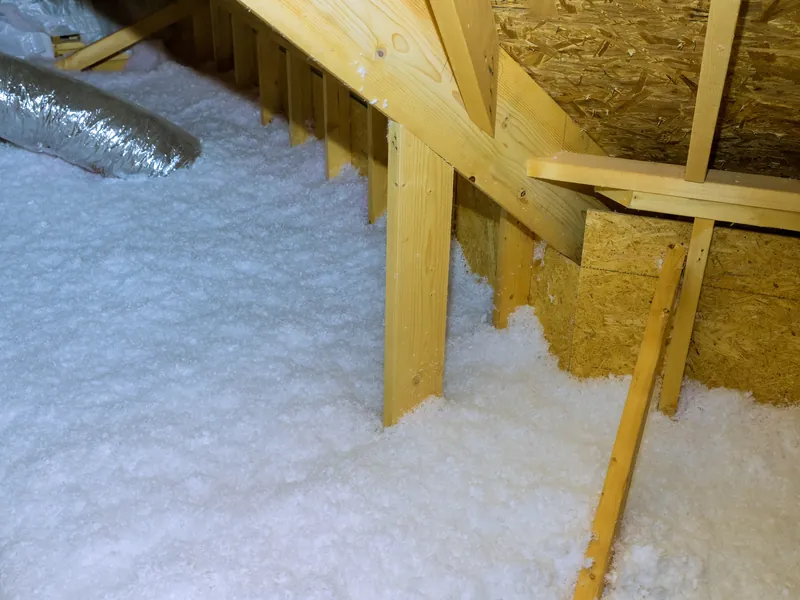
Most people asking about attic insulation in Lakeland are really asking one of three things: how much do I need, will anyone help pay for it, and do I have to get rid of what is up there already. Those have real answers, and two of them are set by other people — the building code and Lakeland Electric.
Polk County is Climate Zone 2, which means R-38
Florida splits into two climate zones for energy code. Zone 1 is the far south — Miami-Dade, Broward, Palm Beach, Collier, Lee, Hendry and Monroe. Everything else, Polk County included, is Zone 2.
Under the 8th Edition (2023) of the Florida Building Code, which has been in force since the end of 2023 and runs until the 9th Edition takes over on 31 December 2026, a Zone 2 ceiling wants R-38. In loose-fill fiberglass that is roughly 12 to 14 inches settled, depending on the product. If you can see the tops of your ceiling joists when you put your head through the hatch, you are nowhere near it.
There is one exception worth knowing, because it decides what happens at the edges of your attic. Zone 2 allows R-30 instead, but only where the full uncompressed height of that R-30 carries all the way over the wall top plate at the eaves. That is a rule about the shallow triangle where the roof meets the wall — the part that gets squashed and skipped — and it exists because forcing R-38 into a space that cannot hold it achieves nothing.
Lakeland Electric pays $300, but the order of operations matters
Lakeland Electric runs a $300 attic insulation rebate for residential customers. The conditions are specific:
- Your existing attic insulation has to be R-19 or less.
- The finished job has to reach R-30 or greater.
- A Lakeland Electric Energy Analyst has to inspect the attic first and issue the rebate certificate.
- One rebate per location, and you can use any contractor or do it yourself.
- Applications go in within 90 days.
The trap is the third one. The inspection is a pre-installation step, not a receipt you send afterwards. Insulate first and there is nothing left for the analyst to assess. If the rebate matters to you, book that visit before anyone starts work — including us.
The other thing worth noticing is the gap between the two numbers. The rebate only asks you to finish at R-30. The building code asks for R-38. Going to R-38 satisfies both, and the extra depth is a small part of the cost once a crew and a machine are already on site. We would rather you spent the rebate on getting it right than on getting it just past the line.
Top it up, or take it out?
Adding new insulation over old is usually the cheaper and better answer. Both layers count toward the total, and dry fiberglass that has simply gone thin is still doing its job — age alone is not a reason to remove anything. Thirty-year-old material that has stayed dry is fine to build on.
Removal earns its cost in a narrower set of situations: rodent contamination, because droppings and urine soak into loose fill and cannot be cleaned out of it; water damage, because soaked material mats down and never recovers its loft; smoke or fire exposure; insulation crushed flat by storage or foot traffic, since loft is most of what it does; and a persistent smell in the house that traces upward.
One thing to check before anyone starts. If what is up there is small pebbly grayish flakes rather than fluffy fill, that may be vermiculite. EPA guidance is to assume it contains asbestos and bring in a licensed abatement contractor. That is not our trade — we stop and tell you.
What has to happen before the insulation goes down
Insulation slows heat. It does not stop air. If there are gaps around can lights, the attic hatch, plumbing stacks and top plates, conditioned air moves through them regardless of how deep the blanket above is. Air sealing first is what makes the R-value you paid for behave like the R-value on the bag.
The soffit vents matter just as much, and they are the most commonly wrecked detail in the trade. Blowing insulation into the eaves until it blocks the vents chokes the airflow the attic depends on, and the moisture that used to leave now stays. Baffles keep that channel open. If a quote does not mention them, ask.
Common questions
How much attic insulation does a Lakeland home need?
Polk County sits in Florida Climate Zone 2, so the Florida Building Code looks for R-38 at the ceiling. In loose-fill that is roughly 12 to 14 inches once settled. Zone 2 does allow R-30 instead where the full uncompressed height of it carries over the wall top plate at the eaves, which is the shallow area where deeper material would just be compressed.
Does Lakeland Electric really pay for attic insulation?
Yes. Lakeland Electric offers a $300 residential attic insulation rebate. Your existing insulation must be R-19 or less, the finished job must reach R-30 or more, and a Lakeland Electric Energy Analyst has to inspect the attic and issue a rebate certificate before the work is done. It is one rebate per location and you can use any contractor. Applications are submitted within 90 days.
Can I get the rebate if I have already had the insulation installed?
No. The Lakeland Electric inspection is a pre-installation step, not something you claim afterwards. Once new insulation is down there is nothing for the analyst to assess. Book the inspection before any work starts if the rebate is part of your budget.
Do I have to remove the old insulation first?
Usually not. If the existing material is dry, clean and simply thin, new insulation goes over the top and both layers count toward the total. Removal is the right call when there is rodent contamination, water damage, smoke exposure, material crushed flat by storage or foot traffic, or a smell in the house that traces back to the attic.
How long does an attic insulation job take?
A straightforward top-up on an average single-family home is often a one-day job when the access is good. Adding a removal stage, working around ductwork, or a house with multiple separate attic spaces will extend it. We give you a time window at the estimate rather than after we arrive.