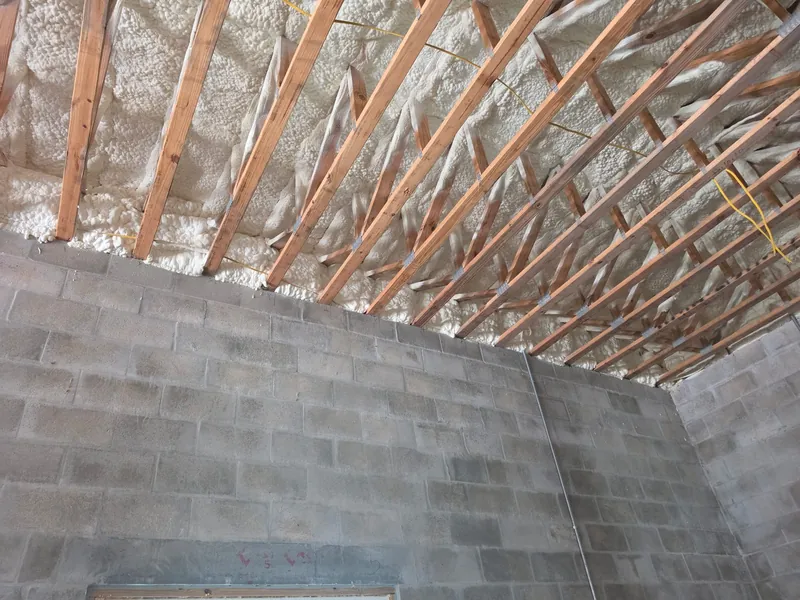
Spray foam seals a building the way nothing else does. It goes on as a liquid, expands into every gap, and cures into a continuous barrier against air and moisture — no seams, no sagging, no gaps around wiring and plumbing where fiberglass always leaves them. In a Florida climate that is doing everything it can to push heat and humidity into your house, that continuity is the whole point.
Why spray foam works in Florida
Most insulation is rated on how well it slows heat conduction. That is only part of the problem here. A Central Florida attic runs 30 to 50 degrees above the outside air on a summer afternoon, and the pressure difference between that attic and your conditioned rooms drives hot, humid air through every unsealed penetration in the ceiling. Fiberglass batts do nothing to stop that airflow — air moves straight through them.
Spray foam is both the insulation and the air barrier. It bonds to whatever it touches and closes the gaps around top plates, recessed lights, bath fans, wiring runs and duct boots. Reducing that air exchange is usually what people actually feel when they say the house is more comfortable, and it is also what protects against the humidity that drives mold and rot in this state.
Open-cell or closed-cell: what we recommend and why
We install both, and the right answer depends on the assembly, not on preference.
Open-cell
Softer and lighter, expanding to roughly 100 times its liquid volume. It delivers in the region of R-3.5 to R-3.8 per inch, so it needs more depth to hit a target R-value — but depth is rarely the constraint in an attic. It is vapor-permeable, which means a roof deck can still dry inward if it ever gets wet, and that is a genuine advantage on older sheathing. It is also the better sound absorber. For most Central Florida attics and interior walls, open-cell is what we specify.
Closed-cell
Dense and rigid, roughly R-6 to R-7 per inch, and at around two inches it also acts as a vapor retarder. It adds measurable racking strength to a wall assembly, which matters in a wind zone. Use it where water is a real possibility or where space is tight: crawl spaces, rim joists, metal buildings, block walls being furred out, and anywhere below the flood line. It costs more per board foot, so we do not put it where open-cell does the job.
Sealing at the roofline instead of the ceiling
This is the single change that makes the biggest difference in 1990s-and-newer Florida homes, and it is worth understanding before you get quotes.
In a conventional attic, insulation sits on the attic floor and the attic is vented to the outside. If your air handler and ductwork are up there — and in most Florida homes built in the last thirty years they are — that equipment is sitting in 130-degree air, losing cooled air through every duct joint on its way to your rooms. Insulating the underside of the roof deck instead brings the whole attic inside the conditioned envelope. The ductwork is no longer fighting the attic, and the upstairs rooms that never quite cooled tend to come into line.
It is a bigger job than a top-up and it is not right for every house — an existing vented attic with a working ridge-and-soffit system, or a roof nearing replacement, may be better served by a blown-in top-up until the roof is done. We will tell you which situation you are in.
What the installation actually involves
Most residential attics are a one-day job. We protect floors and walkways, mask anything that must stay clean, and set up ventilation. If there is old material in the way, insulation removal happens first — foam has to bond to a clean substrate, and covering contaminated or damp material simply hides the problem.
Closed-cell is applied in controlled passes rather than one thick lift, because curing foam generates heat and a lift that is too deep can scorch. Open-cell is applied to the specified depth and then trimmed where it needs to sit flush. Florida code requires foam in an attic or crawl space to be covered by an approved ignition barrier where it remains exposed, and that is part of the job, not an extra. The area needs to ventilate before re-occupancy — typically around 24 hours, following the manufacturer's data sheet for the product we use.
What drives the price
There is no honest square-foot number that fits every house, and we would rather explain the variables than quote a figure that changes the moment we see your attic. Price is driven by the area being covered, the depth and type of foam specified, how much preparation and removal is needed first, how accessible the space is, and whether the job is a straightforward attic floor or a full roofline seal. Estimates are free and done in person, because that is the only way to give you a number that holds.
Utility energy rebates
What you can claim depends on who supplies your power. Lakeland Electric customers can claim $300 on an attic insulation upgrade, provided the existing insulation measures R-19 or less and a pre-inspection happens before the work begins. Duke Energy, TECO and Florida Power & Light run their own separate programs across the rest of our area. We identify which one covers you and handle the paperwork at no extra cost — and if your existing insulation is already better than the threshold, we will tell you plainly that you do not qualify.
Where we install
Attics, walls, crawl spaces, rim joists, metal buildings, pole barns, barndominiums, garages, commercial warehouses, and the irregular spaces where batts never fit properly in the first place.
Common questions
How long does spray foam last?
Properly installed foam is expected to last the life of the building. It does not sag, settle or compress the way fiberglass does, which is why an attic insulated once with foam does not need topping up a decade later.
Will it make my house too airtight?
A well-sealed house needs its ventilation designed rather than left to leaks. On a full roofline seal we look at whether mechanical ventilation is needed and say so up front. Relying on random gaps for fresh air also means relying on them for humidity and dust.
Can it go over existing insulation?
Foam needs to bond to a clean surface, so it is not applied over old batts or loose fill. If your existing material is dry and in good condition, a blown-in top-up may be the more sensible spend — we will say so rather than sell the bigger job.
Does it help with anything besides energy bills?
It reduces outside noise, limits the humidity that feeds mold, and closes the gaps that insects and rodents use. Closed-cell also stiffens the structure it is applied to.