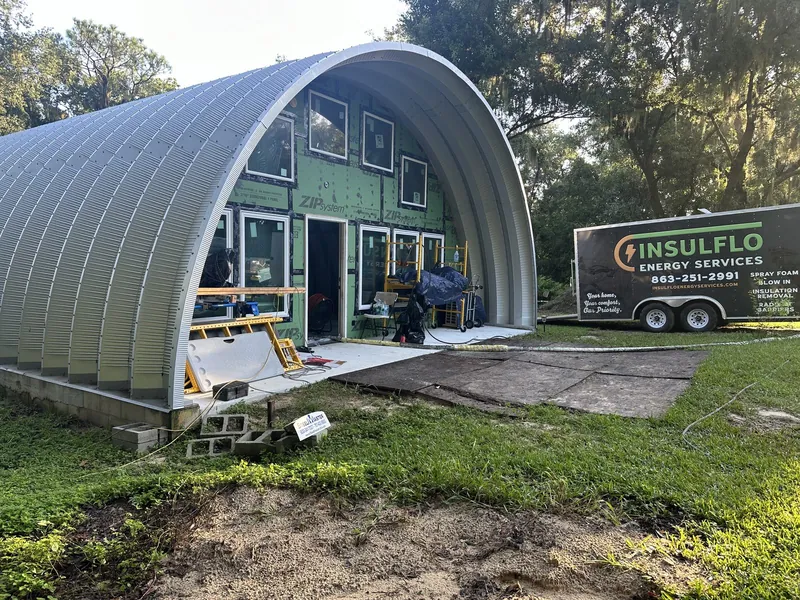
Plant City sits on the Hillsborough side of the county line, and it is two markets in one. Inside the city, roughly a third of the housing predates 1980 — built before Florida had a meaningful energy code. Outside it, in the farmland that makes this the winter strawberry capital of the world, nearly a quarter of all housing is manufactured, and there are metal buildings, coolers and equipment barns everywhere.
What we find in Plant City houses
The historic core, 1880s to 1930s
The Downtown Plant City Historic Residential District holds 185 historic structures — colonial, American Foursquare, bungalow, Tudor and Queen Anne. North Plant City adds another 73. These are wood-frame houses, often with pier foundations and no wall insulation at all. A century of re-roofs, rewires and additions means the attic insulation is usually displaced, contaminated or partly missing.
The 1980s and 1990s peak
The median Plant City home was built in 1989, and the 1980s and 1990s together account for nearly 37 percent of the housing. Walden Lake is the flagship — thirty sub-neighborhoods built between 1977 and 2021 around a 62-acre lake. These homes were built to roughly R-19 or R-30 in the ceiling, about half of what the code prescribes today, and that insulation is now thirty-five to forty-five years old, settled, wind-washed at the eaves and pierced by decades of later work.
Barns, shops and metal buildings
This is the part most insulation companies will not touch. An uninsulated steel building in Florida humidity sweats — condensation forms on the underside of the panels and drips on whatever is stored below. Closed-cell foam sprayed directly to the metal deck stops it, because it is both the insulation and the vapor barrier. We do packinghouses, equipment barns, workshops, horse barns and barndominium conversions throughout the ag country around Plant City, Cork, Knights and Springhead.
Tampa Electric pays for ceiling insulation
Plant City is Tampa Electric territory — there is no municipal utility here, and it is not Duke or FPL. TECO pays $0.16 per square foot for every R-11 of insulation you add, with no published cap.
The pre-approval inspection is mandatory and it is the step that catches people out. A TECO energy analyst must inspect the attic before any work starts. If insulation is recommended they issue a rebate certificate valid for a year, along with a list of approved contractors. Do the job first and there is no rebate. Applications close 90 days after the work finishes. Book the free inspection on (813) 275-3909.
Two others worth knowing. TECO will seal your ductwork for a flat $125 per system after a free inspection, and they reckon leaky ducts cost up to twenty percent of annual heating and cooling. And the Neighborhood Weatherization program provides free ceiling insulation and free duct sealing to qualifying households in designated communities — worth asking about on the same phone call.
The Milton flooding, and why it matters for insulation
In October 2024 Hurricane Milton put more than a foot of rain on Plant City. The city manager called it unprecedented; thirty-five people were rescued from high water in a two-hour window, and the wastewater plant took three times its normal volume. Hundreds of the homes that flooded were in Flood Zone X — nominally a one-in-five-hundred-year risk. County officials described the event as exceeding the hundred-year floodplain entirely.
That matters here for a specific reason. Wet insulation does not recover. Saturated fiberglass or cellulose compacts, loses its R-value permanently and becomes a mold substrate, and in Florida humidity a closed wall cavity will not dry on its own. Drying in place is not a repair. If your home took water in Milton and the insulation was never removed, it is still wrong, and it is still costing you.
Common questions
Do you insulate pole barns and metal buildings, or only houses?
Both, and metal buildings are a real part of what we do around Plant City rather than a sideline. Steel needs a different approach from a house: closed-cell foam sprayed directly to the underside of the panel, because it acts as insulation and vapor barrier in one and stops the condensation that ruins whatever is stored below. We cover packinghouses, equipment barns, workshops, horse barns and barndominium conversions.
My 1920s house has no wall insulation. Can you add it?
Sometimes, but the attic is almost always the better first move. On a hundred-year-old frame house the ceiling is where most of the heat is moving and it is far cheaper to reach. Walls in an occupied historic home are a much bigger intervention, and in some of the Downtown Plant City district houses the framing and finishes make it impractical. We will tell you straight at the estimate if the walls are not worth it.
My house flooded during Milton but the insulation dried out. Is it fine?
It is not. Fiberglass and cellulose that have been saturated do not recover their R-value — the fibers compact and stay compacted, and the material holds moisture against the framing. The EPA's guidance is that porous materials wet for more than 48 hours generally have to be discarded. In Plant City humidity a closed cavity will not dry on its own, whatever it feels like to the touch. If it took water in 2024 and was never opened up, it needs to come out.
Is Plant City on Tampa Electric or Duke?
Tampa Electric. Plant City has no municipal utility of its own, and it is not Duke or FPL territory despite sitting close to the Polk County line. That matters because the rebate works completely differently from the one your friends in Lakeland or Lake Wales will describe to you.
How quickly will I notice a difference?
On the first hot afternoon. The change people report most often is not a lower thermostat setting but that the air conditioning stops running continuously through the late afternoon, and that the rooms under the worst part of the attic stop being noticeably warmer than the rest of the house. The bill follows in the next cycle.
Where we work
Plant City and the communities around it — Walden Lake, Walden Pointe, Turkey Creek, Springhead, Trapnell, Cork, Knights, Bealsville, Coronet, and the newer builds at North Park Isle, Farm at Varrea, Timber Ridge, Park East and Fieldstone.
We install spray foam, blown-in insulation, and handle insulation removal after water or rodent damage. We also fit energy-efficient windows and repair storm damage.