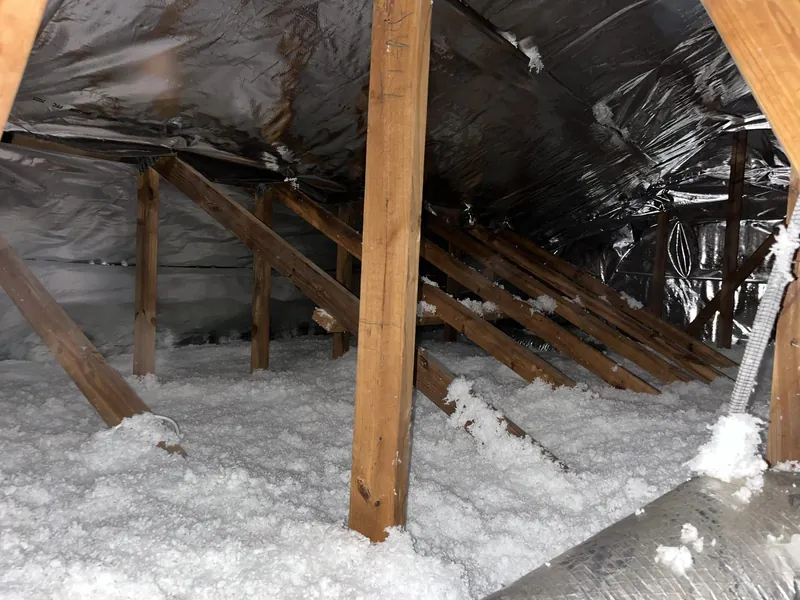
The two questions worth settling before anyone quotes you are how deep the insulation has to go, and whether Tampa Electric will put money toward it. Both have specific answers.
Hillsborough County is Climate Zone 2, so the target is R-38
Florida has two energy-code climate zones. Zone 1 covers the far south — Miami-Dade, Broward, Palm Beach, Collier, Lee, Hendry and Monroe. Every other county, Hillsborough included, is Zone 2.
The 8th Edition (2023) Florida Building Code has been in force since the end of 2023 and runs until the 9th Edition replaces it on 31 December 2026. It looks for R-38 at a Zone 2 ceiling. In loose-fill that is broadly 12 to 14 inches once it has settled. A quick test that costs nothing: if the tops of the ceiling joists are visible from the hatch, you are well short.
Zone 2 permits R-30 instead in one specific place — where the full uncompressed height of it carries over the wall top plate at the eaves. That covers the shallow wedge at the edge of the attic where a deeper product would only be crushed. It is a sensible allowance, not a shortcut for the whole attic.
Tampa Electric pays by the square foot, and the inspection comes first
Tampa Electric's ceiling insulation rebate is $0.16 per square foot for each R-11 of insulation installed. Because it scales with both area and depth rather than being a flat sum, a bigger attic and a deeper job are worth proportionally more — which is the opposite of how most people assume rebates work.
Two conditions decide whether you get it at all:
- A pre-approval attic inspection is required before the insulation goes in.
- The application has to be submitted within 90 days of the work being finished.
The first one catches people out. This is not a receipt you post in afterwards — once the new material is down, the inspection that qualifies you cannot happen. If the rebate is part of how you are paying for this, arrange it before scheduling any installer, ours included. Tampa Electric's program line is 813-275-3909, weekdays 8am to 5pm.
The rebate is open to work done by a licensed contractor in the program and to homeowners installing it themselves.
When the old insulation has to come out
Most of the time it does not. New material goes over dry, clean, simply-thin insulation and both layers count toward the total. Age by itself is not a reason to remove anything.
Removal is genuinely necessary in a short list of cases: rodent contamination, because waste soaks into loose fill and cannot be cleaned out of it; water damage, because soaked material mats down and does not recover its loft; smoke or fire exposure; insulation packed flat by storage or foot traffic; and a persistent smell in the house that traces upward into the attic.
If what is up there looks like small pebbly grayish flakes rather than fluffy fill, stop. That may be vermiculite, and EPA guidance is to assume it contains asbestos and use a licensed abatement contractor. We are not that trade and we will say so rather than disturb it.
Barns, workshops and metal buildings are a different job
Plant City has a lot of steel buildings, and an attic approach does not transfer to them. Steel conducts heat straight through and holds almost no thermal resistance of its own, so overnight the panel drops below the dew point of the air inside and water forms on it. Batts and bubble wrap disappoint people here because neither stops air and moisture reaching the underside of the panel. Closed-cell foam sprayed directly to the steel removes the cavity where that happens. If that is your building rather than your house, the metal building page covers it properly.
Air sealing and soffit vents decide whether any of it works
Insulation slows heat; it does not stop air. Gaps at can lights, the attic hatch, plumbing penetrations and top plates let conditioned air move straight through whatever depth sits above them. Sealing those first is what makes the rated R-value behave like the rated R-value.
And the soffit vents have to stay clear. Blowing loose fill into the eaves until the vents choke is the most common way a well-intentioned attic job creates a moisture problem. Baffles hold that channel open. If a quote does not mention them, ask why.
Common questions
How much attic insulation does a Plant City home need?
Hillsborough County is in Florida Climate Zone 2, so the Florida Building Code looks for R-38 at the ceiling, which is roughly 12 to 14 inches of settled loose-fill. Zone 2 allows R-30 where the full uncompressed height of it extends over the wall top plate at the eaves, since deeper material in that shallow area would only be compressed.
How much is the Tampa Electric attic insulation rebate?
Tampa Electric pays $0.16 per square foot for each R-11 of ceiling insulation installed. Because it is calculated on area and depth rather than a flat amount, a larger attic and a deeper installation are worth more. A pre-approval attic inspection is required before the work, and the application must be submitted within 90 days of completion.
Do I need the Tampa Electric inspection before the work starts?
Yes. The inspection is a pre-approval step. Once new insulation is installed the inspection that qualifies you can no longer be carried out, so arrange it before booking any installer. Tampa Electric can be reached on 813-275-3909 on weekdays between 8am and 5pm.
Do you insulate barns and metal buildings around Plant City?
Yes, and it is a different job from an attic rather than a variation on one. Steel conducts heat straight through and condenses moisture on its underside, so closed-cell foam sprayed directly to the panel is the approach that works. Batts and bubble wrap tend to sag, gap and trap moisture against the metal.
Will new insulation go over what is already in my attic?
Usually, yes. If the existing material is dry, clean and just thin, new insulation is installed over the top and both layers count toward the total R-value. Removal is reserved for contamination, water damage, smoke exposure, material crushed flat, or a smell that traces back to the attic.