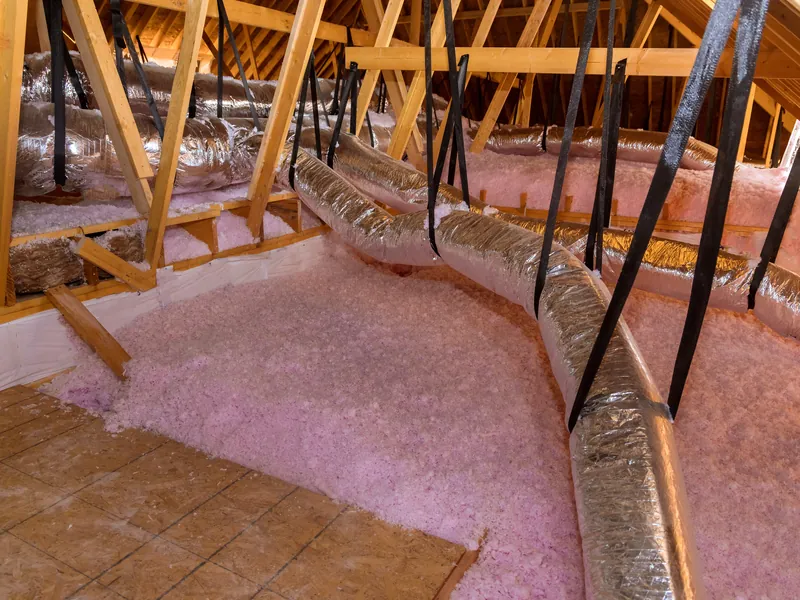
Before spending money on attic depth, it is worth knowing which problem you actually have. In a lot of Tampa houses, adding insulation at the ceiling is the right move. In others it will not touch the thing that is bothering you, and a bigger air conditioner will not either.
Where your ductwork runs changes the answer
If the ducts run through the attic — and in a great many homes here they do — then the cold air your system makes is traveling through a space that can sit far hotter than the air outside. It warms on the way. What arrives at the upstairs vents is not what left the air handler, and a larger unit only means paying more to lose the same amount of it.
Adding depth at the ceiling does not fix that. It insulates the rooms below and leaves the duct sitting in the same hot attic. What addresses it is sealing at the roofline instead, which brings the attic inside the conditioned envelope so the duct is running through a space close to room temperature.
That is not the right answer for every house, and it costs more than a top-up. If your situation is simpler and cheaper than that, we will say so. But it is worth understanding before anyone quotes you a new system.
Hillsborough County is Climate Zone 2 — the ceiling target is R-38
Florida's energy code splits the state into two zones. Zone 1 is the far south: Miami-Dade, Broward, Palm Beach, Collier, Lee, Hendry and Monroe. Everything else, Hillsborough included, is Zone 2, where the 8th Edition (2023) Florida Building Code looks for R-38 at the ceiling. That is broadly 12 to 14 inches of settled loose-fill.
Zone 2 also allows R-30 in one place — where its full uncompressed height carries over the wall top plate at the eaves. On older Tampa bungalows with shallow eaves that allowance matters, because forcing a deeper product into a space that cannot hold it just compresses it and gains nothing.
Tampa Electric pays toward it, if the inspection comes first
Tampa Electric's ceiling insulation rebate is $0.16 per square foot per R-11 installed, so it scales with the size of the attic and the depth of the job rather than being a flat figure. A pre-approval attic inspection is required before installation, and the claim goes in within 90 days of the work finishing.
That inspection is the step people miss. It is not a receipt submitted afterwards — insulate first and the assessment that qualifies you cannot be done. Their program line is 813-275-3909, weekdays 8am to 5pm. Our Plant City page covers the same rebate in more detail, since it is the same utility.
What we check before recommending anything
Depth is the last thing to settle, not the first. Air sealing comes before insulation, because insulation slows heat but does nothing about air moving through gaps at can lights, the attic hatch, plumbing penetrations and top plates. Seal those and the R-value on the bag starts behaving like the R-value in the room.
Soffit vents have to stay clear. Filling the eaves until the vents choke is the quickest way to turn an insulation job into a moisture problem, and baffles are what prevent it.
And if the existing material is dry and simply thin, it stays and we build on it. Removal is for rodent contamination, water damage, smoke exposure, insulation crushed flat, or a smell in the house that traces upward. If what is up there is pebbly grayish flakes rather than fluffy fill, that may be vermiculite — EPA guidance is to assume asbestos and use a licensed abatement contractor, which is not us.
There is a longer write-up of the upstairs-cooling problem in our article on why your upstairs will not cool in Tampa.
Common questions
Why is my upstairs still hot after adding attic insulation?
Most often because the ductwork runs through the attic. Insulation at the ceiling protects the rooms below it but leaves the duct in the same hot space, so the cooled air warms on its way to the upstairs vents. Sealing at the roofline instead brings the attic inside the conditioned envelope, which is what actually changes the temperature of the air arriving upstairs.
How much attic insulation does a Tampa home need?
Hillsborough County is Florida Climate Zone 2, so the Florida Building Code looks for R-38 at the ceiling, roughly 12 to 14 inches of settled loose-fill. Zone 2 permits R-30 where its full uncompressed height carries over the wall top plate at the eaves, which matters on older homes with shallow eaves.
What does Tampa Electric pay toward attic insulation?
Tampa Electric pays $0.16 per square foot for each R-11 of ceiling insulation installed, so the amount scales with attic size and installed depth. A pre-approval attic inspection is required before the work begins, and the claim must be submitted within 90 days of completion.
Is spray foam at the roofline better than insulation at the ceiling?
It depends on where your ductwork and air handler are. If they sit in the attic, sealing at the roofline brings that equipment inside the conditioned space and is usually the change that fixes an upstairs that will not cool. If your ducts are not in the attic, it is a more expensive answer to a problem you may not have.
Do you have to remove the insulation that is already there?
Usually not. Dry, clean insulation that has simply gone thin stays where it is and new material goes over the top, with both layers counting toward the total. Removal is warranted for rodent contamination, water damage, smoke exposure, material packed flat by storage or foot traffic, or a persistent smell traced to the attic.