Two questions decide most St. Petersburg attic jobs: how much insulation the roof shape will physically accept, and whether Duke Energy will contribute. Neither answer is the same as it would be in Lakeland.
Pinellas is Climate Zone 2, and the eaves rule matters more here
Florida's energy code has two zones. Zone 1 is the far south — Miami-Dade, Broward, Palm Beach, Collier, Lee, Hendry and Monroe. Pinellas, like most of the state, is Zone 2, where the 8th Edition (2023) Florida Building Code looks for R-38 at the ceiling. That is roughly 12 to 14 inches of settled loose-fill.
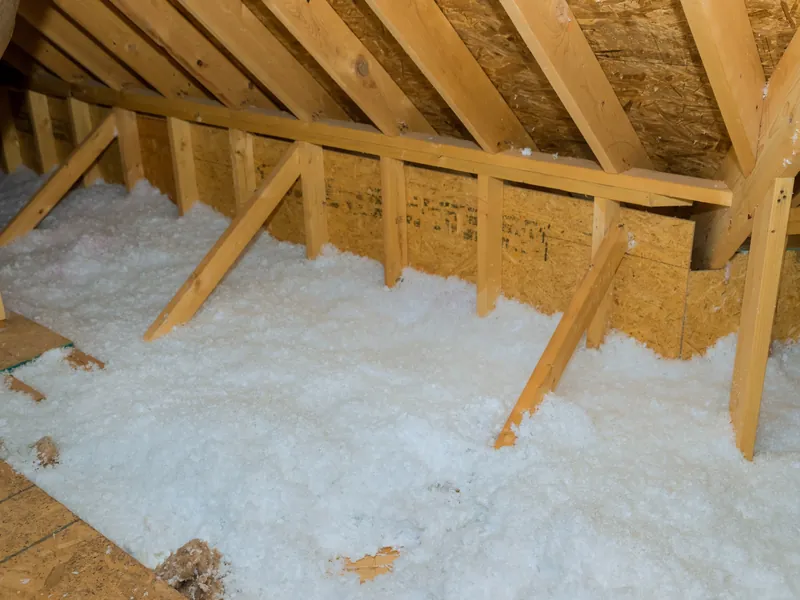
The part that matters on a low-slope roof is the exception. Zone 2 allows R-30 instead where the full uncompressed height of it carries over the wall top plate at the eaves. On a shallow roof the triangle where the deck meets the wall is tight, and the honest position is that you cannot get R-38 into it without crushing the material — and crushed insulation does not perform at its rated value. The code allowance exists precisely for that geometry.
What this means in practice is that a good quote for a low-pitch house should say something different about the middle of the attic than it says about the edges. If a quote gives one number for the whole space without mentioning the eaves, it has not accounted for the roof you actually have.
The Duke Energy program, and what it requires
St. Petersburg is Duke Energy territory, and Duke runs its own attic insulation rebate. The structure is different from a municipal utility's flat payment, and the prerequisites are worth knowing before you plan around it:
- You must have had a Duke Energy home energy check completed within the past 24 months.
- The weighted average R-value of the existing insulation, across the whole attic above conditioned space, must be R-19 or less.
- The home must have whole-house cooling and/or electric heating.
- Manufactured homes are not eligible.
- A Duke Energy-approved contractor must be used for the work.
- The installation has to be accessible for verification by a Duke Energy representative.
That fifth condition is the one to settle first, because it constrains who can do the job if the rebate is central to your budget. Current amounts and the approved contractor list are published by Duke directly, and we would rather you confirmed those with them than took a number from a contractor's website that may be out of date.
If the rebate is not the deciding factor, none of the above applies and the job is simply a job.
Humidity is the other coastal difference
An attic near the water spends more of the year with humid air moving through it. That does not change the R-value you are aiming at, but it raises the cost of getting the ventilation detail wrong.
Soffit vents have to stay clear. Blowing loose fill into the eaves until the vents choke is the most common way an insulation job creates a moisture problem, and on a low-pitch roof it is easier to do by accident because the space is tighter to begin with. Baffles hold the channel open. If a quote does not mention them, ask.
Air sealing comes before depth for the same reason it does everywhere: insulation slows heat but does nothing about air moving through gaps at can lights, the attic hatch, plumbing penetrations and top plates. Sealing those is what makes the rated value behave like the rated value.
Topping up versus taking it out
Dry, clean insulation that has simply gone thin stays, and new material goes over it — both layers count toward the total. Age alone is not a reason to remove anything.
Removal is the right call for rodent contamination, because waste soaks into loose fill and cannot be cleaned out of it; water damage, because soaked material mats down and never recovers its loft; smoke or fire exposure; insulation packed flat by storage or foot traffic; and a smell in the house that traces upward.
One stop-work check. If the existing material is small pebbly grayish flakes rather than fluffy fill, it may be vermiculite. EPA guidance is to assume it contains asbestos and use a licensed abatement contractor. That is not our trade, and we will tell you rather than disturb it.
Common questions
How much attic insulation does a St. Petersburg home need?
Pinellas County is in Florida Climate Zone 2, so the Florida Building Code looks for R-38 at the ceiling, roughly 12 to 14 inches of settled loose-fill. Zone 2 allows R-30 where the full uncompressed height of it extends over the wall top plate at the eaves, which is the relevant allowance on the low-pitch roofs common here.
My roof is low-pitch and the edges are tight. Can I still reach R-38?
Across the open part of the attic, usually yes. At the eaves, often not, and forcing it there is counterproductive because compressed insulation does not deliver its rated value. Florida Climate Zone 2 permits R-30 at that edge where its full uncompressed height carries over the wall top plate, which is exactly the situation a shallow roof creates.
Does Duke Energy pay for attic insulation in St. Petersburg?
Duke Energy runs an attic insulation rebate program with its own prerequisites: a Duke Energy home energy check completed within the past 24 months, existing insulation averaging R-19 or less across the attic, whole-house cooling and/or electric heating, and a Duke Energy-approved contractor carrying out the work. Manufactured homes are not eligible. Current rebate amounts and the approved contractor list should be confirmed with Duke directly.
Does being near the water change what my attic needs?
It does not change the R-value target, but it raises the cost of getting ventilation wrong. More of the year is spent with humid air moving through the attic, so keeping the soffit vents clear with baffles matters more, and on a low-pitch roof those vents are easier to block by accident because the eave space is tighter.
Can new insulation go straight over the old?
Usually yes. If the existing material is dry, clean and simply thin, new insulation is installed over the top and both layers count toward the total. Removal is reserved for rodent contamination, water damage, smoke exposure, material crushed flat by storage or foot traffic, or a persistent smell traced to the attic.