Milton made landfall at Siesta Key. Helene flooded Sarasota without ever making landfall here at all. And between those two events sits a housing stock that includes some of the most architecturally significant — and most awkward to insulate — homes in Florida.
The Sarasota School problem, and how it is actually solved
Between 1941 and 1966, architects including Ralph Twitchell, Paul Rudolph, Victor Lundy and Tim Seibert built what became known as the Sarasota School of Architecture — flat and low-slope roofs, cantilevered overhangs, reinforced concrete, exposed post-and-beam structure and enormous planes of glass. Lido Shores holds the best-known concentration, including Rudolph’s 1953 Umbrella House.
They were designed for a world before air conditioning: shade, cross-ventilation and thermal mass. Retrofit central air into one and the assembly fights you, for reasons that have nothing to do with how much insulation you buy:
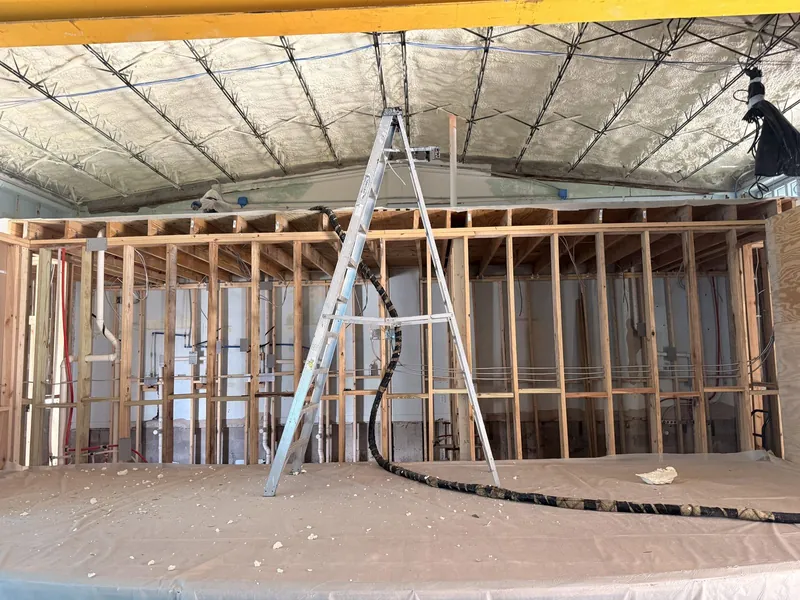
- There is often no attic at all. The roof deck is the ceiling. Blown-in has nowhere to go, so the answer is closed-cell foam applied to the underside of the deck — creating an unvented, conditioned assembly — or rigid board above the deck at re-roof time.
- Exposed beams and tongue-and-groove decking mean insulating from inside would destroy the thing you own the house for. Above-deck insulation at re-roof is frequently the only preservation-compatible option.
- Cavity depth is minimal. You cannot fit R-38 of fiberglass into a four-inch assembly. Closed-cell foam’s higher R per inch is often the only route to a real number.
- Historic designation may apply. Sarasota has roughly 180 locally designated buildings plus multiple districts, and exterior changes including windows can require review.
Elsewhere the city is more conventional: 1920s Craftsman and Mediterranean Revival in Laurel Park (around 270 homes) and Burns Court, and 1960s concrete block by the thousand — South Gate alone is about 2,100 block homes with terrazzo floors, carved out of orange groves. Those block houses, with their settled original insulation, are the ones most likely to fall under FPL’s R-8 rebate threshold.
FPL rebates work differently here
This area is Florida Power & Light territory, and FPL’s insulation program works on a completely different principle to Duke’s or TECO’s. Worth understanding before anyone quotes you.
- Ceiling insulation rebate: $220, applied as an instant credit on the contractor’s invoice.
- The qualifying test is your existing insulation, and the threshold is low. Your attic must measure less than R-8. That is the only R-value gate — FPL sets no minimum finished R-value.
- The home needs whole-house central electric heating and cooling, and an accessible attic — flat roofs and inaccessible attics are explicitly excluded.
- Work must be done by an FPL-approved Participating Independent Contractor.
- A/C upgrade rebate: $200 at SEER2 15.2 or above.
Under R-8 sounds harsh, but a great many pre-1990 attics around here genuinely measure that low once you push a ruler into the settled fiberglass. The way to find out is FPL’s free Home Energy Analysis — call 800-342-5375 and they will come and measure it.
Two honest notes. FPL has no window rebate and no current duct rebate, whatever older pages claim — for windows the money comes from My Safe Florida Home instead, which offers free wind-mitigation inspections and grants up to $10,000 covering impact windows and doors. And if your attic already measures better than R-8 you will not qualify, in which case we will tell you plainly whether the job still pays for itself on runtime alone.
Three storms, three completely different failures
Sarasota took three named storms in twenty-five months and each broke things differently. It matters, because the repair differs.
Ian, September 2022 — river flooding. Landfall was well south at Cayo Costa, but the counties north of the track, Sarasota included, saw the Myakka, Peace and Alafia rivers crest to record levels. Freshwater, inland, away from the coast.
Helene, September 2024 — surge without a landfall. The storm came ashore two hundred miles north near Perry and still drove five to seven feet of surge from the Anclote River south to Longboat Key. A sensor at the Venice pier measured 5.71 feet above MHHW. The National Hurricane Center recorded stilled waterlines inside many homes.
Milton, 9 October 2024 — direct hit. Landfall at Siesta Key at 8:30pm, Category 3, 115 mph. Surge of four to six feet from Longboat Key to Venice. Gusts to 102 mph at the airport, 7.58 inches of rain, and 45 tornadoes across the state that day.
Many homes took water twice inside a fortnight. Fiberglass batts and blown cellulose in a flooded wall cavity are porous and absorbent and, per the EPA, generally cannot be salvaged — the mold clock runs out in 24 to 48 hours. In a climate with 75 degree overnight lows and an eight-month rainy season, wet insulation left in a closed cavity does not dry. That is the argument for full removal rather than drying in place, and it is the most common work we do here now.
One local rule worth knowing: Sarasota County requires flood-damaged exterior HVAC equipment to be elevated when it is replaced if it sits in a flood zone. FEMA also issued new flood maps effective March 2024, replacing studies in some cases completed before 1992 — your zone may have changed without you noticing.
Where we work
Across Sarasota — Laurel Park, Burns Court, Gillespie Park, Southside Village, Arlington Park, Central-Cocoanut, the Rosemary District, Newtown, Indian Beach and Sapphire Shores, McClellan Park and South Gate on the mainland; Lido Key and Lido Shores, St. Armands, Bird Key and the northern part of Siesta Key on the barrier islands. We also work Longboat Key, Casey Key, Venice and Osprey.
We install spray foam, including closed-cell applications to flat and low-slope roof decks where conventional insulation will not fit, plus blown-in insulation. We handle insulation removal after flooding, and fit energy-efficient windows and storm damage repairs.